Saturday
just gone, 25th April, was ANZAC Day here in the antipodes. In fact, it was the 100th Anniversary.
I
am used to commemorating the end of the War with our Remembrance parades in the
UK, honouring the 11th hour of the 11th Day of the 11th Month, when
First World War hostilities formally ended in accordance with the armistice signed by Germany. In Australia it is done slightly differently,
as the main commemoration occurs for the beginning of the Gallipoli campaign. The
land offensive landed at dawn on 25th April 1915, and as such ANZAC
Day is commemorated with Dawn Services on 25th April each year, followed by the laying of wreathes and
then civic and military parades which are very similar to the UK Remembrance Day
parades - the only real difference being that things were much less formal here in Australia.
I
have written a brief piece about the Gallipoli Campaign, and put it at the end
of this post in dark red, so you don’t have to read through it if you don’t want to; but I did
want to share the gracious words of Ataturk, first President of the new
Republic of Turkey and an Ottoman commander at Gallipoli, on the memorial at
Anzac Cove, Gallipoli, Turkey:
"Those heroes that shed their blood
and lost their lives…
You are now lying in the soil of a friendly country.
Therefore rest in peace.
There is no difference between the Johnnies
and the Mehmets to us where they lie side by side
here in this country of ours…
You, the mothers,
who sent their sons from faraway countries
wipe away your tears;
your sons are now
lying in our bosom
and are in peace,
after having lost their lives on this land they have
become our sons as well."
Ataturk, 1934
Here
in Townsville, I was collected by a friend at 4am so that we could get to the
park and ride that was laid on to take spectators to the Dawn Service. Before
the service began, documentary footage about the Gallipoli campaign was
screened. Then the service began, with readings and speeches continuing as the
sun made its way above the horizon.
The
quiet and still of dawn darkness and the anticipation of the sun rising lent an
extra layer of solemnity to proceedings. While obviously there is no comparison
and we cannot possibly imagine what it would have been like, being tired and
uncomfortable, and slightly chilly (we are still in the tropics here, so
although the nights are starting to cool it will never be very cold) helped
people to empathise more with what those young men must have been going through
100 years ago.
Following
the conclusion of the Dawn Service, most people dispersed to get breakfast and
coffee and let their kids go and play, before returning to line the streets
ready for the parade.
 |
| We walked past this Field of Poppies installation by a local craft group |
 |
| Watching the sun come up as we eat breakfast |
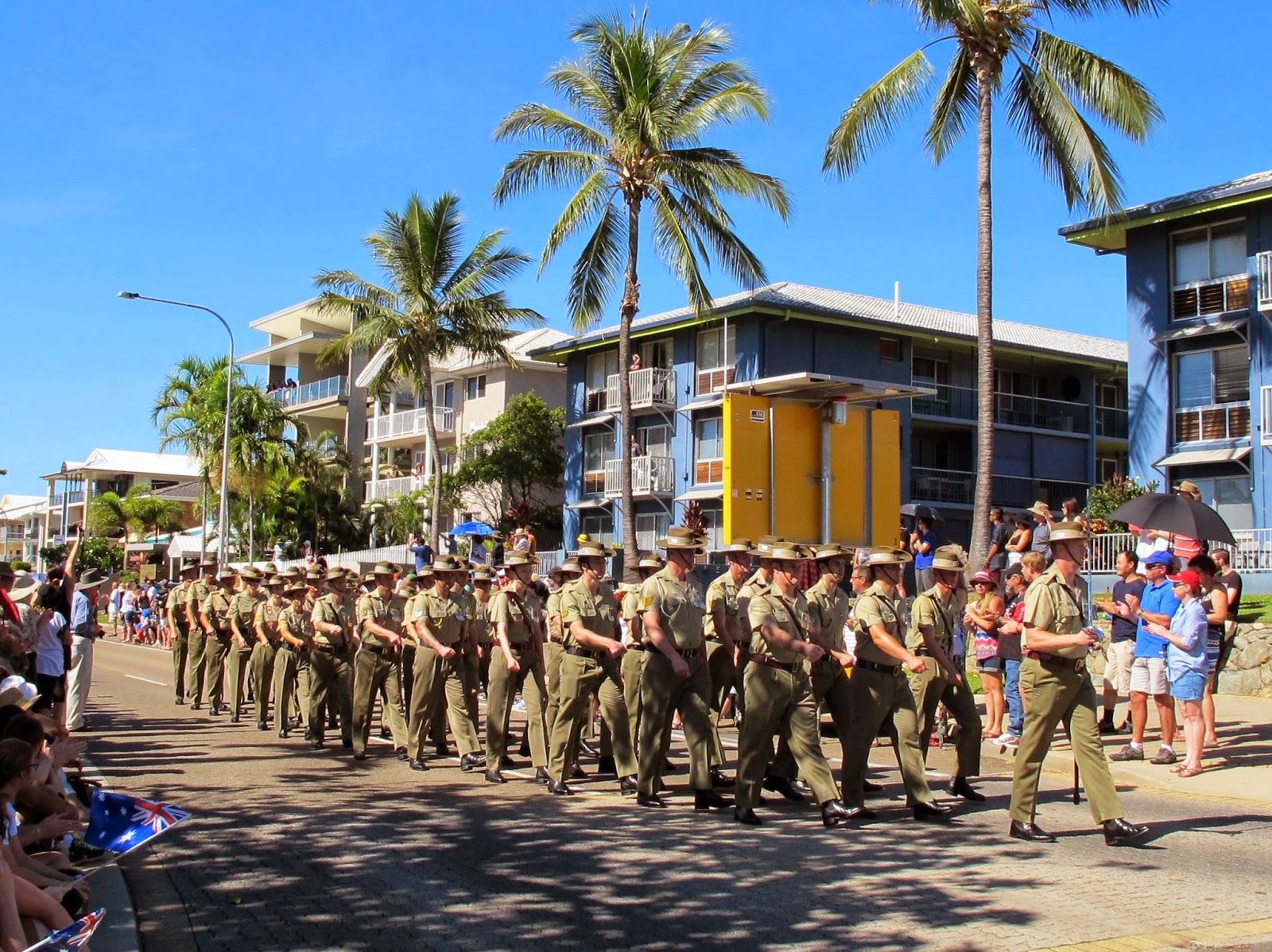
Townsville
has a very large proportion of military families due its Army and Air Force
bases, so the largest contingent of marchers was the Australian Defence Force.
Also parading though were various Veterans Groups, hobbyists with restored
military vehicles, elderly residents, Volunteer humanitarian groups, local
bands and even school children in their uniforms. There was even a flyover by a
couple of planes, including a local tourist seaplane called the Red Baron.
 |
| "The Spirit of Mateship" |
 |
| My husband is in there somewhere! |
 |
| Septimus the Pony, he's a Regimental Mascot. |
.jpg) |
| The Pioneer Sergeant, with beard and axes. Hipsters be jealous! |
 |
| Air Force working dogs - and spare a moment for that poor lady who had to march 2.5km in those heels. When will the military learn that it is no longer the 1940s, and women don't have to dress like that? |
 |
| Nursing uniforms |
The
Gallipoli Campaign in brief:
During
the First World War, the Ottoman Empire (now Turkey) was an ally of Germany, and the
Russian Empire was an ally of the Allies. The Dardanelles is a narrow strait in north-western Turkey, providing a sea route through to the Black Sea and Russia, and as such was a tactically important area during the First World War.
In order for the Allies to gain control of the Dardanelles and establish a sea route for their navies to the Black Sea and Allied Russia, an Allied force was sent. The aim was the capture of the
Ottoman capital, Contantinople (now Istanbul), initially via Naval force and then via landings on the northern banks of the
Dardanelles, formed by the Gallipoli peninsula.
The initial naval attempt used damaged British and French ships attempting to force the
Dardanelles. They made headway, however the attempt failed after too many losses from artillery
bombardments from the defending Turks, newly laid sea mines and strong currents that destroyed submarine attempts. Therefore, a land
campaign was devised to eliminate the Ottoman artillery and clear the way for
the naval operation.
This
campaign was designed to be a quick hit, but there was a delay of several weeks
until the plan could be put into action, and this time was not wasted by the
Ottoman and German defenders. Good preparations were made to repel an invasion,
and this combined with the Allies’ inadequate mapping and intelligence, plus a
failure to keep momentum and capitalise on ground gained early on, with the
result that a stalemate ensued.
The
landings at Gallipoli began at dawn on 25th April 1915, and the campaign ended
with an Ottoman victory and defeat for the Allies on 9th January
1916. Here in Australia, it seems to now be part of folklore that the joint
Australian and New Zealand force – the ANZACs – fought a spirited battle and
suffered an unfair defeat due to callous disregard by the British masters for
their Colonial servants. In reality, the ANZACs fought their battles alongside
troops from Britain, Ireland, France, Nepal (Gurkhas), India, Canada, Palestinian
Jewish volunteers who had been displaced by the Ottoman Empire, civilian
volunteer logistic support, and probably others as well. While I’m sure there
were poor decisions made by Allied commanders, there was also poor information to go on as
intelligence was not adequate.
What
is definitely true though is that at this time, for white settlers Australia
and New Zealand were very much overseas parts of Britain. In the Gallipoli
campaign these ‘new’ countries came of age, and a new sense of nationhood was
forged. These junior nations had been called upon to make a vital contribution
in a very violent grown-up world, and had established themselves as useful countries in their own rights. The sacrifices made at Gallipoli helped to cement a new national consciousness and an idea of 'the Anzac Spirit'.
For
the Ottomans too this campaign was important in the forging of a new nation.
The victory was not cheap, in one infantry regiment every single man was either
killed or injured in defending their land. Commanding these troops was Mustafa
Kemel, later to be known as Ataturk. This final defence of the motherland
formed a basis for the later Turkish War of Independence, and the formation of
the Republic of Turkey under Ataturk as its first national leader.
After
the failure of the Allied campaign, the evacuation of the Allied troops went more
smoothly. Despite the bitter winter conditions, good planning and ingenious tactics
and deception meant that the Australians suffered no further casualties as they
evacuated. The final troops to leave were elements of the British Troops who
had been amongst the first to land.
At
the end of the Gallipoli Campaign, casualties on both sides were similarly heavy,
with losses of over 56,600 lives each:
The
Allies lost 56,707 lives; the ANZACs lost 11,430 lives between them, and
British forces lost 34,072 with 7,654 either missing in action or prisoners of
war.
The
Ottomans lost 56,643 plus another 11,178 either missing or prisoners.
I
don’t want to disrespect anyone by belittling their loss and not including them
here, so below is a table from Wikipedia listing casualties:
|
Gallipoli
casualties (not including illness)
|
|
|
Dead
|
Wounded
|
Missing
&
Prisoners
|
Total
|
|
Ottoman
Empire
|
56,643
|
107,007
|
11,178
|
174,828
|
|
United
Kingdom
|
34,072
|
78,520
|
7,654
|
120,246
|
|
France
|
9,798
|
17,371
|
–
|
27,169
|
|
Australia
|
8,709
|
19,441
|
–
|
28,150
|
|
New
Zealand
|
2,721
|
4,752
|
–
|
7,473
|
|
British
India
|
1,358
|
3,421
|
–
|
4,779
|
|
Newfoundland
|
49
|
93
|
–
|
142
|
|
Total
Allies
|
56,707
|
123,598
|
7,654
|
187,959
|


